

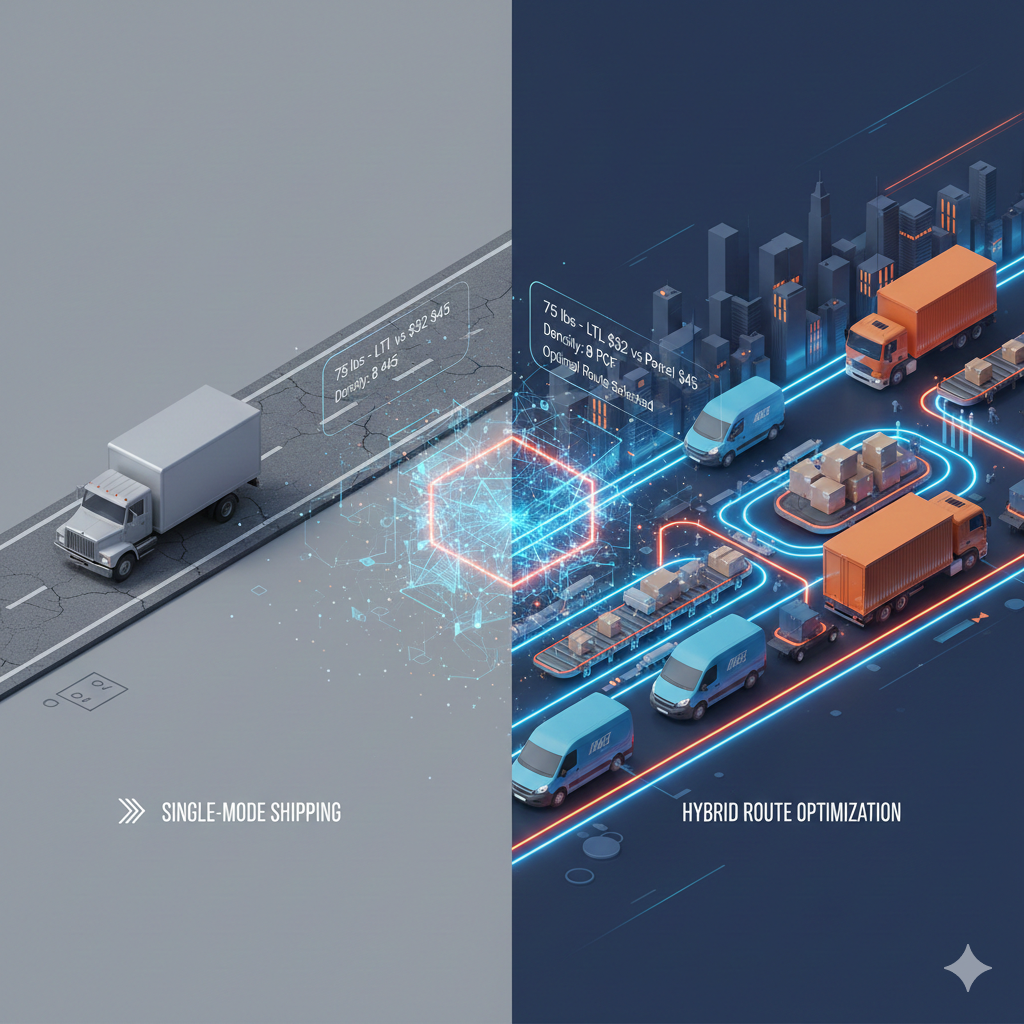
The shipping landscape is changing faster than ever. With major parcel carriers implementing 5.9% rate increases and the LTL market undergoing seismic shifts, including FedEx's planned freight spinoff, shippers face a critical decision: stick with a single-mode strategy or embrace the flexibility of hybrid shipping.
The answer is increasingly clear. Leading companies using CloudLeap are discovering that the smartest shipping strategies don't force a choice between parcel and LTL. Instead, CloudLeap's intelligent platform leverages both modes strategically, automatically selecting the optimal carrier and service level for each shipment based on weight, dimensions, destination, and urgency.
If you're still locked into a one-size-fits-all approach, you're likely overpaying—and here's how CloudLeap solves this problem.
The Case for Hybrid Shipping: Why One Mode Isn't Enough
Traditional shipping strategies typically default to either parcel carriers (UPS, FedEx, USPS) or LTL freight providers. But this binary thinking leaves money on the table.
The challenge? Modern B2B shipping demands don't fit neatly into categories. You might ship:
• 50-pound packages that could go parcel or LTL
• Multiple small packages to the same destination (better consolidated as LTL)
• Oversized items under 150 pounds (the gray zone between parcel and freight)
• Urgent shipments where speed trumps cost
• Bulk orders where cost savings matter most
The critical insight: The crossover point between parcel and LTL isn't fixed—it varies by lane, carrier, accessorial requirements, and even day of the week. CloudLeap's platform compares both options dynamically for every shipment, so you're always optimizing instead of guessing.
Major Industry Shifts Reshaping Hybrid Strategies
Two major developments in 2025 are accelerating the need for sophisticated multi-carrier approaches:
FedEx Freight Spinoff: The End of Cross-Service Incentives
FedEx's announcement to spin off its LTL unit by June 2026 represents a fundamental restructuring of the market. For years, high-volume shippers leveraged their combined parcel and freight spend to negotiate better rates across both services.
What's changing: The separation means fewer cross-service incentives. Your LTL volume with FedEx Freight may no longer boost your parcel discounts—and vice versa. This fundamentally different economic reality makes carrier diversification more important than ever.
Parcel and LTL freight have different cost structures, capital requirements, and operational models. The spinoff allows both entities to optimize independently, but it also means shippers can no longer rely on portfolio leverage with a single provider.
How CloudLeap helps: CloudLeap already connects to 125+ parcel and LTL carriers, so you're not dependent on any single provider's bundled pricing. When the FedEx spinoff happens, CloudLeap customers won't feel the impact—our platform automatically finds the best rates across your entire carrier network, regardless of how providers restructure their businesses.
NMFTA Classification Changes: Density Takes Center Stage
The National Motor Freight Traffic Association's reclassification update, effective July 19, 2025, represents the biggest change to LTL pricing in decades. Over 40% of products shipped via LTL will be affected.
The new reality: Density becomes the primary factor in LTL pricing, rather than the old commodity-based classification system. This shift makes real-time rate comparison even more critical, as the same shipment might price dramatically differently across carriers based on how they calculate density-based pricing.
How CloudLeap helps: CloudLeap's rating engine automatically calculates density-based pricing across all your LTL carriers and compares it against parcel options. You don't need to become an expert in NMFTA classifications—CloudLeap handles the complexity behind the scenes, ensuring you always get accurate quotes that reflect the new pricing methodology.
How CloudLeap Delivers Hybrid Shipping Benefits
CloudLeap's platform is purpose-built to deliver these measurable advantages:
1. Automated Cost Optimization
CloudLeap compares parcel and LTL rates for every shipment in real-time. A 75-pound package might cost $45 via parcel but only $32 via LTL with a liftgate—CloudLeap automatically identifies the savings and routes the shipment accordingly. No manual quoting required.
2. Carrier Leverage Built-In
With CloudLeap connecting you to multiple parcel and LTL carriers simultaneously, you gain negotiation leverage automatically. Carriers know they're competing for each shipment through our platform, which improves your contract pricing and ensures accountability.
3. Smart Service Level Matching
CloudLeap's business rules engine lets you define when to prioritize speed versus cost. The platform automatically uses overnight parcel for urgent orders while routing routine replenishment through economical LTL—based on rules you configure once.